Thursday, August 29, 2013

Surrender

In his popular book, "Wisdom of Healing", Dr. David Simon says that there are at least two things in our life that are out of our control:  sleep and death.  The best way to manage them and to obtain our inner peace is to "totally surrender" to both these inevitable forces.

Those people who have occasionally suffered from insomnia understand why 'sleep' is actually something we cannot control.  We can only say that ' going to bed'; but that doesn’t necessarily mean 'going to sleep'.  The harder we ‘try to sleep', the faster we are 'chasing our sleep’ away.

In his clinical observations of terminally ill patients, Dr. Simon also observed that those patients who were preoccupied with 'death', had relatively low remission rate compared to those who totally surrender to ‘death’, focusing instead on the daily tasks to make every day count.

A twist of Dr. Simeon's statement of surrendering to 'death' is that, if it is not our time to die, we have nothing to worry about. As Ann Morrow says, “ Practice words of Trust: ‘I believe. I am confident. I am not afraid.’  According to Morrow in her book, “Trust-in-God Therapy”, those bold sentences will build bridges across crevasses of fear in your mind, heart, and soul. We are here for a purpose.  The following story describes how I brushed off death by a hair in the worst flood Taiwan had since 1945, the so called 1959 August 7 flood, or 八七水災*1.

The fateful event took place on August 8, 1959.  I was only 13 years old. Dad was working at Taichung (台中).  He did not come home on August 7. My other siblings were either at Taipei (台北), or Taichung (台中), or abroad.  At home, there were only 3 persons: Mom, my sister, Lina (麗娜) who was only 7 years old, and me.

Typhoon Ellen has brought torrential rains yhat pounded on my neighborhood since August 7, 1959.  This typhoon was formed in the seas south of Japan, and brought a tropical depression from around the Pratas Islands to Taiwan.  Rainstorms raged for three days, from August 7 through August 9, covering almost the entire western region, with the heaviest rainfall coming on the 7th. The incessant rain was accompanied by continuous, frightening thunder and lightning. In nine hours (at night of August 7) 811 mm. of rain dumped itself on Changhua (彰化) and its adjacent areas. By early next morning, all the streets in Changhua (彰化) were inundated. The previous record was 412 mm.

Normally, the vast area of forest in central or eastern Taiwan was able to absorb this large amount of rainfall. Flooding had occurred in the past.  But no one had expected that the flooding this time would be different from the previous experiences.  However, since Chiang Kai-Sheik’s  (蔣介石) regime brought 1 million retreated, rugged and undisciplined troops and civilians over to Taiwan, deforestation had taken place at an acceleration rate.  A large portion of the forest has been either converted into cropland or residential areas.  The natural flood prevention system has been largely lost.  The authorities should have been aware of the fact that this large amount of rainfall could cause severe damage to many west-central counties of Taiwan.

Additionally, the weather stations of the U.S. in the Pacific, mostly in Japan also gave Chiang’s regime a warning: that the tidewater from the sea was invading Taiwan at the same time of the unprecedented rainfall.

Did Chiang Kai-Sheik (蔣介石) regime do anything with those warning?  No,  nothing!  No evacuation order was given, nor any siren sounded to warn the residents of the pending flood danger either.  Most American remembers 2005’s Hurricane Katrina in Louisiana.  President Bush and his administration were heavily criticized for their disaster prevention and relief efforts. In Taiwan, no one dared to criticize the government. The regime’s major concern was to repress the populace.  Taiwanese under Chiang’s regime were 10 times more miserable than under the Japanese occupation.

The relentless seven hour of continuous rainfall occurred at night while everyone was asleep.  Torrential rain is very common in Taiwan.  Nobody gave a second thought about the impending danger of the typhoon.

Rain actually stopped in the morning of August 8.  Mom’s first concern was if the roof in the kitchen was leaking again.  It had happened many times in the past.  This time was no difference.  I placed a bucket to collect the rain water leaking from the roof.  Although the dirt streets were flooded about ankle-deep, the floor in our house was only a little wet.  My sister and I helped Mom to wipe the wet floor to keep it dry.  Everything looked normal. Taiwanese had experienced those experiences these problems thousand times before, not knowing that this time would be different.

Suddenly, we heard a loud voice thundering, “The embankment of Ta-Tu-Ke (or Big-Stomach River ( 大肚溪), the river that separates Taichung (台中) and Chang-Hua (彰化) counties), has failed.  Run, Run, Run for your life.”

The person who called to us to run was Mr. Huang who lived a few houses away from my house.  In the normal day, he was quiet and soft-spoken.  We kids called him O-Zi-San (ぉじさん, a Japanese phrase adopted in Taiwanese language. It means ‘Mr’ but in a very respectful manner.). He did not have any connection with the police or government institution.  Should we trust him?

Mom’s first reaction to the call was to put coal-blocks on a high table so that she would have something to make a fire with and cook when the typhoon was over.  My sister and I were helping her to put coal blocks on the table.

Mr. Huang cried out again.  This time was even more forceful with an authoritative tone. He told Mom, “ O-Ba-San (ぉバさん, a respectful addressing for ‘Mrs’.  This was also a Taiwanese-adopted Japanese phrase).  Run quickly. Stop your work now.  Strangely, Mom listened to his call this time.  We quickly ran outside looking for 2-story or 3-story concrete houses that was about a quarter mile away.

Surely, the flood water did rush in our neighborhood.  Starting at the ankle height, after 5 blocks, it became knee height.  By the time we reached a 3-story-house, it was already chest-height.  Mom held my hand while I held my sister’s hand with my free hand.  Three of us half-ran, half waded to reach the 3-story house.  The door was already open.  About a dozen neighbors were there to greet us.  Along the main street, doors of every 2-story or 3-story concrete houses were open showing the genuine compassion and hospitality of  theTaiwanese to strangers.  The host and the hostess of the 3-story house actually prepared warm meals for us.  We stay at their place on the night of August 8.  We returned home on August 9. If we would have run 5 minutes later, all three of us would have been drown.

Through the window of the 3-story concrete house, we witness the flood scenes with great horror for the drowned neighbors and collapsed houses.  The official casualty of the flood was 669 dead, 852 injured, 377 missing and 248,184 homeless--victims of Taiwan's worst flood disas¬ter since 1898.

One of the most tragic scenes was witnessed near a railway signpost outside of Changhua (彰化) when flood workers sighted a pair of legs sticking out of a heap of debris. As they dug out the body of a six-year-old boy, they found three more bodies.  They were two younger boys and a woman, who appeared to be about thirty and several months pregnant. Ap¬parently she was the mother of all three. They held each other's hand in a firm grip.

The strangest thing happened in this story was about Mr. Huang’s calling for his neighbors to run for their lives. These days when everyone has a phone and internet, such a flood warning by Mr. Huang would not be a surprise at all.  However, the flood was in 1959, and no one in our neighborhood has a telephone.  A few families might have radios, however, radios do not work when there is no electricity.  The utility had been damaged by the storm.   He did not have any government connection.  How did he know that the embankment of the river failed (Actually, he was correct in this aspect. The official records did show that the embankment of Ta-Tu-Ke failed in the morning of August 8)?  How could this quiet and soft-spoken O-Zi-San (おじさん) come to speak with a loud and convincing tone to ask every family to leave at once? How could Mom believe in him and have saved three lives of the family? Any missteps or misjudgment could result in drowning of a whole family.

This goes back to the main theme of Dr. Simon’s book of “Wisdom of Healing”: There are something in our life that simply cannot be comprehend by the ordinary reasoning of a human being.  Dr. Simon who teaches Ayurveda medicine (an ancient form of Indian medicine) in his book calls this type of event, a spiritual divine.  Whether you would like to call it a God’s miracle, or a spiritual divine miracle, they are actually the same.  Death is something out of our control, and it is best to leave this matter to God, or the Spiritual Divine.  Surrender is the best strategy to deal with ‘death’.  If it is not our time to die, we will live.


Figure 1:  Flooding of the Big-Stomach River.
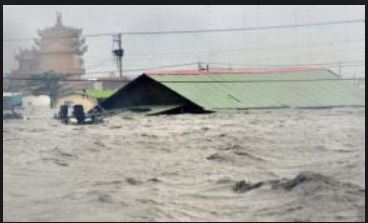


Figure 2:  Flood reached almost to the roof. and 
Figure 3  Taiwanese wading through the flooding water to a safe location.  Photos shown above.


Figure 4:  Mass funeral for the flood victims.

p.s.  The story was written based on author’s best recollection and also based on the internet research.  It may not 100% factual.  However, the essential part of the story, Mr. Huang crying out to tell everyone to run for lives is true, although his name may not be Mr. Huang.  Another take of the story is that we are here today simply because someone else did something for us without asking for anything in return.  In this story, it was Mr. Huang.  Therefore, as a good human being, we should also do the same thing for other people without asking anthng in return.  It is just simply the right thing to do.

*1  The flood occurred on August 8, 1959.  However, for unknown reason, the flood is known to historians as the August 7 flood.

Thursday, August 15, 2013

Love is a potent medicine

The clock struck 9:00 PM while Liz was working on her homework on the second floor and heard the garage door open. She felt relieved because that night, she felt alone. Dad and her older sister, Alice, were in New Jersey visiting universities. Alice was to decide which one to attend the next year. Mom was helping Grandma take care of Grandpa who had suffered a stroke last year. “Mom is finally home.” she said to herself, without paying too much attention. She knew that Mom would come upstairs, say Hello, and give her a big hug.

 It was thirty minutes later, and Liz had not seen her Mom come upstairs to give her a hug.  She began to worry.  She came downstairs and found her mom’s purse, but could not find her.  “Mom, mom.” She yelled as hard as she could but there was no answer.  She searched every room and found nothing.  But as soon as she opened the garage door, she was shocked. Her Mom had collapsed on the floor and was unconscious.

Young (she was only 12 years old), panicked and frightened, Liz called her family’s best friend, Trudy.

Trudy wasted no time in calling 911, and an ambulance came immediately to take her Mom, Betty to the hospital. She had suffered a massive stroke and was treated in the Intensive Care Center of the hospital. Trudy also immediately call Betty’s husband, Jim, in New Jersey.  Jim and his daughter flew home on the first flight the next day
.
There was a tremendous fluid accumulation in her skull that the doctors immediately performed dangerous brain surgery to drain the fluid to release the pressure on the brain.  The  stroke was so severe that the doctor was not very optimistic that she would live, or if she lived, how well she would recover her speech and motor abilities. 

When word of the tragedy went out, Betty and Jim’s church mobilized. A meal train was set up to take care of the family’s needs for daily meals. The Deacons in the church took turns  visiting her to give the family necessary support. More importantly, her husband, Jim, stayed by her bedside as long as the hospital allowed.

Jim worked for a corporation near town. Knowing that his retirement could come immediately, he took on-line classes from a seminary school and earned a certificate for lay ministry pastor.  He is a devoted Christian and very generous in offering help for other suffering church members, not knowing that this time the person he would offer care to, was his wife.

The doctors induced a coma in his wife during the first week in the Intensive Care Unit. The doctor told Jim that because the time duration between the onset of the stroke and the time for medical intervention is so critical, the hope for surviving the trauma let alone the recovery is very small.

“Doc, my wife will live.” Jim said, “She is too young to die.  She loves her daughters.  The daughters need their Mom. She is in the youth ministry of the church. The youths in the church need her.  God has work for her.”

“We will do our best.” The doctors said.

Betty was under “induced coma” for 1 week.  That week was probably the longest week for the family.  After a week, the doctors gradually reduced the anesthesia medication.  Betty’s eyes responded to the light, and her toes could move under stimuli.

The good news spread like a wild fire.  Her friends cheered, because they knew Betty would not die.

After two weeks, the anesthesia medication was stopped. One day, Alice, Liz and Jim were with Betty.  Liz stood by the left-hand-side of the bed while Alice was standing on the right hand side of the bed. Jim asked his wife, “Where is Liz?” Betty using her left hand pointed in Liz’s direction. “Where is Alice?” Again, Betty used her left hand to point in Alice’s direction. In both questions, Betty’s answers were 100% correct. This implied that Betty retained cognitive function after the stroke.  Another cheer for her friends and family! 

A few days later, one of the church friends visited her. She asked her friend to give her coffee by drawing pictures on a piece of paper.  Because life-support systems were still covering her nose and mouth, she could not communicate with friends by talking.  However, she could draw and spell words on piece of paper even the words were often not spelled correctly and pictures were not drawn in correct proportion.

After 1 month, the life support systems were stopped.  Betty could breathe on her own, she also recovered her swallow function.

During the first month, Jim kissed her forehead to say good night before he went home to retire.  On the night when life support systems were removed, Jim was concerned with her swollen mouth and nose.  So, he kissed her on the forehead.  Betty used her left hand and grabbed Jim’s finger and brought his finger to her lips, saying to Jim (although she still could not talk) that kissing on the forehead didn’t count.  She wanted Jim to kiss her on the lips.

After 2 months in the intensive care unit, Betty was finally released to the regular hospital care unit. Betty basically recovered her speech and her cognitive function.  Her left-hand was unaffected by the stroke (Fortunately, she is a lefty lady.) Her right hand and her right leg needed more physical therapy to improve.  Betty and Jim celebrated their wedding anniversary In the hospital by ordering Chinese take-out food. Together, they watched a movie in the hospital; the same movie they watched when they first dated 25 years ago. 

Betty was finally released from the hospital in May, 2013, approximately 4 months under hospital professional care. The day she was released, her neighbors tied green ribbons to welcome her home.

The doctors told Jim that Betty’s recovery was remarkable and was beyond expectation from any rational reasoning. Certainly, a miracle was worked in her recovery after her traumatic  stroke.
 
Dr. Andrew Weil, a well-respected physician and professor at the Institute of Integrated Medicine at Arizona State University said that each one of us has his or her innate potential for self-healing.  However, when barriers of healing are present, the patient loses his or her innate potential to heal.  Medication intervention can do one part.  However, one cannot ignore the other important part of healing:  love, hope, and faith.  They are potent medicine.

P.S.  This is a true healing story.  However, I have changed names and places to protect the identity of the individuals.  The story may be 100% factual truth, but I have tried my best.  Besides, for a story teller, factual truth is less important than emotional sincerity.  I do believe that love is a potent medicine that can heal.

Friday, August 2, 2013

Miracle

Miracles come from time to time.  We read about it.  We hear about it.  Sunday sermons preach about it. However, most people probably miss an essential element for the miracle to come into their lives.  To allow miracles to come into our lives we must have ‘Hope’ and ‘Faith’.

My brother’s miracle story tells more about the importance of hope in order for a miracle to happen.

The incident took place in 1936 in central Taiwan.  I was not even born yet.  My second older brother Ting-Kai was 1 year old and was afflicted with serious pneumonia.  Dad and Mom brought him to the hospital.  After several attempts to heal my brother the doctor told my parents that there was nothing he could do to save the child. He asked my parents to prepare for the worst.

Mom was desperate and heart broken.  Uneducated, neither could she read or write, she clung to her last hope, based on what a fortune-teller would tell her about the child’s fate.  By the way, she was very superstitious.  She told my dad; “Mr. Yang, who lives in the next town, is a very good fortune-teller.  Could you go there to ask him about the fate of our child"?

Mom did not want to go herself.  She could not emotionally handle the bad news, not knowing what he would say.

Dad obediently followed her request. 

Three hours later Dad came home.  He told Mom that Mr. Yang said that everything would be all right.  The child’s life could be saved. 

Excited, the couple rushed back to the hospital pleading to the doctor one more time (This time, it was a different doctor from previous visit.).  The doctor reluctantly complied and miraculously, Ting-Kai  recovered from deadly pneumonia.

Mom and Dad were so excited that they asked a professional photographer to take a family picture that included Dad, Mom, and Ting-Kai on the day when Ting-Kai recovered from pneumonia. Dad kept the picture in a very secure album.

Many years after the death of my Mom, Dad said; “ Did I ever go to the fortune-teller to ask for the fate of my child"?   (Dad continued) “No!  I actually did not go to Mr. Yang to ask for the fate of my child.  I just went to a friend’s place, smoked some cigarettes and played chess to kill some time.  After 3 hours, I came home to tell your Mom that everything would be all right.”

Indeed, Dad lied to Mom.  But it was a very good white lie.  The lie saved Ting-Kai’s life.

Dad continued to say very philosophically;  “How can we save our child if one of us does not have  hope or faith that he can be saved"?

In 1995, while my brother Ting-Kai was in Taiwan, Dad brought that precious photo to him.  He told him to keep the photo with him and tell about the story to other people he  cares about.

I was at Ting-Kai’s place in New York last year where I learned about the story and I so I am writing  it down to share with my readers.

Only with hope and faith can we allow  miracles to happen to our life.

How was my brother Ting-Kai doing since that incidence?  Well, he is doing very well.  He received his doctor degree in economics and computer science in Germany.  He speaks fluently on four languages: English, German, Mandarin, and Taiwanese.  He speaks with enough competency on Spanish and Japanese.  He served more than 30 years with IBM.  He is now a professor at Furdam University in the upper New York State.  He is a very good role model for me.  My career path almost follows his career path.  He is 11 years older than I.

Ting-Kai received his doctoral degree in economics and computer science in 1968(?) from Germany.

Monday, July 29, 2013

Amazing Grace

I was not a born Christian.  Christianity is not the traditional religion in Taiwan.  The traditional religion of Taiwanese is a worship of various gods and goddesses.  These gods and goddesses stem from ancestors, fork heros, those related to the land and of course the Budda. The traditional Taiwanese religion is practiced by more than 75% of the populace today.  During the 50's or 60's, the time when I was a teen, the traditional religion was worshipped by more than 95% of the populace.  Yet, within this cultural norm, I had contact with Christianity  not through the Mormon missionary although they were everywhere, but through a girl in the neighbor, and through the generous American Food Assistance program.

Taiwan in the 50's and 60's was a typical third-world country. I lived in central Taiwan which  was probably the most impoverished neighborhood.  We did not have a sewer system.   Nor did we have a municipal water supply. Every day, everyone had to walk long distances to get water from a well.  There was a river flowing by, yet since there was no effective municipal waste disposal program, people living in the neighborhood would dump everything into the river flowing by.  Sadly, the same river was also used by women who washed their family's clothes. The infectious disease was rampant, and child mortality was very high.  I would like to give my readers some idea about child mortality. My family mortality statistics can be used as examples.  I had one brother two years older than I and another brother two years younger than I. Both did not live beyond 6 months of age.  Today, because of my profession as a teacher, I have to show videos and images of poverty in Africa and India in class.  I told students that I lived through a similar experience as a teen and I believe that all  the stories about poverty in the videos are true.

The house I lived as a child had a living area approximately 300 square ft., or about 1/5 of my current Wisconsin home.   In such a small area of the living space, we had dad, mom, one brother and one sister living together (the other older brothers or sister did not live with us.).  The house was divided into several living quarters; the best room, or the room at the front was a shrine, used only for worship. In the shrine, typically, there was a tall table for offering, a ceramic-made vessel that contained sand so that a burning incense could be placed on, and a kneeling pad.  God or goddess’ images were hung on the wall.  Next to the shrine was a big bed room in which everybody sleep together: mom, dad brother and sister. The kitchen would be behind the bed room; then there was an outhouse. 

Because it was hot most of the time, and no one can afford air conditioner or air fan, every house in the neighborhood would usually leave front door open to catch cool wind occasionally blowing through.  Living in such a condition, we knew exactly the religion of our neighbor, because if they were on traditional religion, their front room would be the shrine, unless they had changed their faith to other religions.

The neighbor next to us lived a family with a girl of about my age. She was a cheerful girl.  When I was playing with her, we always had a good time.  Their family also followed the faith of Taiwanese folk religion, until one day, I noticed that they had removed the shrine and replaced it with a living quarter.  Wow, her family had converted to Christianity.   Taiwanese is usually quite tolerant to religion of other faith that her faith conversion at most only raise few eyebrows. It did not actually create a commotion.  Since she was such a cheerful and popular girl that everyone in her age still wanted to be her friends even with such a faith conversion.

Later, I found out her family attended a Baptist church in town.  One day, she even invited me to attend her church's Sunday school.  After initial hesitation, I accepted her invitation.  At Sunday school, I learned a Taiwanese version of the Hymn, Amazing Grace.  I loved the tune and the words of the hymn.  Besides singing the hymns, we also learned about bible stories.  More importantly, the Sunday school provided snacks for the kids.  Because of this sort of 'free meal', my mom did not oppose me to attend the church.  From her view point, as long as her kids were fed, she would not stand their ways.

There was also a tremendous advantage for the impoverished families to have contacts with a church at the time.  During late 50's and 60's, generous American launched a food assistance program to Taiwan; these programs were initially administered through church organizations.  Although the program aimed for everyone, Christian or non-Christine, a church connection was always helpful because we knew that we would not be left out from this program.   I remembered the smiling face beaming out from my mom when she baked bread in boiling butter.  Today, we would say that butter can raise cholesterol.  Well, at the time, butter provided needed calorie to those under-nourished impoverished Taiwanese.

Those good days stayed about 5 months until when an epidemic of diphtheria hit our neighborhood.  Diphtheria is caused by a gram-positive bacteria and is highly contagious and deadly.  Patients infected with the bacteria would have a severe inflammation producing white-like coating on mucus of respiratory system eventually kills the patient by cutting off air supply.  Taiwanese literally translation of the disease is Pai-Ho, or White Throat.  My Taiwanese medical doctor friend in Wisconsin told me that during his 40+ years of career as a doctor including his internship in Taiwan, he has not seen any case of diphtheria because immunization programs have wiped out this disease.  But this was not the case when I was a teen.  There was no immunization campaign at the time.  As a result of this epidemic, schools were close and churchs were close for about a month.

One night, I had noticed a group of people gathered at my friend's house.  They sang hymns, and they left quietly after the gathering.

Finally, the epidemic was under control; schools and churches were open once again.  However, when I went back to Sunday school, I did not see her.  She was gone.  The diphtheria had taken her life away.  I also realized the gathering at her house few weeks ago was actually a ceremony of her church to say good-bye to her.

I was so sad that I did not come back to the church until many years later when I was at the U.S in the 80's.  Even with this late faith conversion, I still remembered my cheerful friend, the beautiful hymn of Amazing Grace, and the American generosity of food assistance program at the time.

Today, I had to teach students how poverty affects mortality; I realize that poverty is number one killer compared to other causes such as smoking or accidents (see the attached statistics chart in Figure 1.)   I have witness the terror of poverty; it took away my two brothers, my friend in the neighbor, and many other people I did not know. 

As I look back my teen life, not only I survived such hardship, I also came to U.S. to get the best education one can have, have successful careers, have raised two wonderful sons.  I have nothing else to say but a deep gratitude from my heart.  The odd of getting what I have now is extremely small.  This is a very good reason to say thank you to the amazingly God's grace and blessing on me.   If you don't mind, I will write the words of amazing grace as follows:

Amazing grace!
How sweet the sound
That saved a wretch like me.
I once was lost, but now am found,
Was blind but now I see

Shout, shout for glory,
Shout, shout aloud for glory;
Brother, sister, mourner,
All shout glory hallelujah.
Attached are two Figures.

Figure #1:  Causes of Global Deaths; 
Figures 2:  My son with my dad in late 18’s when Victor was about 15-16 years old. 

Figure 1:  Poverty is the number 1 killed for the global population, source: Cengage Learning, 2013.


Figure 2: Victor and dad in front of the house that I grew up as a teen. My son was with my dad in late 80’s when Victor was about 15-16 years old. During his high school year, he spent on summer attending a boarding school sponsored by Taiwanese government to learn about Taiwanese language and culture. By that time (about late 80’s), living conditions in Taiwan had improved tremendously. The outhouse has been converted to bathroom. There was municipal water supply and there was municipal waste pick up system set-in-place. Politically, martial law was lifted and universal health care system was enacted. Dad was also very practical. Even he still followed Taiwanese religion, he did not believe that god and goddess should occupy a whole living quarter. He had converted the shrine into a working room where he wrote, painted calligraphy, and sang karoke.


Saturday, July 6, 2013

Her name is Kathryn.

The painting club I belong to is a loosely organized group with approximately 8-9 regular members getting together every Wednesday, from noon to 3:00 PM at one Assisted Living facility in Appleton. Most of the regular participants are retired senior citizen except me who is a senior citizen but is still working, and a young fellow in the 30's who is an unemployed or under-employed law school graduates. Excluding that young fellow, I would say the average age of the group is approximately 68. None of us is a professional painter. Sometime ago, the group has hired a teacher to instruct the members. But later, because the instructor had some medical problems and stopped coming to the group.

I joined the group probably a year ago through a church friend who was trying to get her mother who is the 90's to have something to occupy. Through informal conversation with the members, almost all of us have some medical, emotional, or relational issues that include: diabetics, high blood pressure, high cholesterol, divorced or separated or marriage strained problems, or have to take an extreme patience to take care of ailing spouse. Despite the difficulty, everyone of them has some unique story that can be inspirational or uplifting. Kathryn is one of them

I met Kathryn in one of the painting occasion. We sat in the the same table covered with a plastic top to avoid spilling of the paint. She was painting a greeting card with flowers as her themes using her right hand. She is probably 5-6 years older than I, in the age of 74 or 75. She started the conversation,

"My dominant hand is the left hand. But the Parkinson disease I had few years crippled my left hand, so I have to train my right hand to do the painting." She said.

Now, I realized that Kathryn is afflicted with a disease that is capable taking away her motor ability. I have seen many of my friends who got the same disease withdrawn, depressed, and eventually paralyzed and lose any hope for life and joy.

"When did you begin to paint?" I asked.

"About two years ago, about the same time I knew I got Parkinson." She said.

"How many greeting cards have you made so far, since I started painting." I asked

"Quite a few." She said.

"What do you do with the finished painting? Frame them or send them out as greeting cards?" I asked.

"Well, I gave my finished work to those person who are also afflicted with the Parkinson disease whether I know them or not know them. I told them, even with such a terrible disease, we don't have to give up our life."   after hearing this,  I was very moved.

"For the best work, I gave it to my doctor who sees me every month. I give my doctor a big hug, and says to him and to myself, 'This is my affirmation that I will not give up life even I have such a terrible disease."

Friends, even in our very humble group, I see courage, I see hope. I also see the face of God. I don't know if you agree with me or not.

 
One of Kathryn's painting.

Monday, July 1, 2013

Healing Story--How I eradicate drug-resistant H. Pylori (Part 2)

I should credit the success of my battle over H. Pylori to several books that I have read and instilled into my mind for daily practice:

" Eat to live"  and "Super Immunity" by Dr. Joe Furmann.
" Change your brain to change your body", by Dr. Daniel Amen
" The Wisdom of healing", by Dr. Deepak Chopra and Dr. David Simon
"8-week to Optimum health", audio book by Dr. Andrew Weil.

Diet regiment:

I would call the diet I have is "Dr. Furman's diet".  This includes not to eat any animal-based foods except occasionally fish and eggs.  No sugar-based foods that include soft drinks, juices, breakfast cereal, quick oat, breads, even bagels.   I eat full plate of vegetables and fruits including leafing vegetables, carrot, sweet peppers, all kinds of berries (strawberries, blue berries, etc), apples, bananas, all kinds of nuts and avocado which is my major calorie source.  No pro-inflammatory foods including vegetable oil, dairy products such as cow milk and cheeses.  No artificial sweetener-based foods including diet coke or diet Pepsi.

Major staples:

Pro biotic based foods such as Kefir, yogurt.  I did the home-made fermented cabbage.  Every dish will include cabbage, fresh-cut garlic. 

Whenever it is possible, I would have cabbage, onion, garlic, broccoli, and cooked mushroom.

Mind-body connection in digestion

I eat only when I feel hungry.  This means that I may have only 2 meals a day, not 3 meals.  It is OK. Digestion takes a lot of energy.  Besides, intermittent fasting is good for us anyway.

I would not eat if I feel upset.  An upset mind would not digest food well.

I practice meditation and prayers at least twice a day.

I exercise religiously everyday.  Playing tennis and folk dance are better medication than the drugs.

Supplement

I took Omega-3, and anti-oxidant capsules recommended and supplied by Dr. Andrew Weil.  I took adequate but not overdose zinc and vitamin B supplement recommended by Dr. Andrew Weil for vegetarian diet.

Discipline

This self-imposed regiment would be very difficult to follow if I have a weak mind.  I must thank God for giving me such a gift that I am a very discipline person and I have a strong mind.

End-Note:

I hope my healing story brings hope to my friends who has loving persons in their lives suffer similar situations.  Healing is possible if we follow the wisdom of Furmann, Amen, Chopra and Simon.  But, the responsibility to heal is on us, not on any doctors.

Healing Story--How I eradicate drug-resistant H. Pylori (Part 1)

Dr. Deepak Chopra says that if you have a healing story, share it, because the story carries 'hope' element that can transform and heal people surrounding me.  This is why I am going to share my small victory against drug-resistant H. Pylori with my friends so that you all will be benefited from my story now or in the future.

The story started on April, 2012 when I had endoscopy test for my chronic gastritis.  The test showed that I had H. Pylori infection.  Initially, I did not worry about it very much. 

"Big deal?  A 2-week antibiotic treatment will eradicate the bug."  I said it to myself.

Well, I was wrong.  It took 3-regiment of antibiotic treatment to show 'negative' breath test.  I was about to celebrate the results, the doctor said that the victory could be temporary.  The bug may come back.  The doctor asks me to take breath test every 3 months. 

I followed doctor's direction and did the breath test in September and in December of 2012.  It all came back negative.  However, in March, 2013, the breath test came back positive.

I was devastating.  The bug I have is a very tough bug--a drug-resistant H. Pylori.

Doctor told me to take a 21-day antibiotic regiment treatment again.

"What is the odd of eradicating H. Pylori with this new regiment of treatment?" I asked.
"About 50-50"  The doctor replied.
"Does that mean if this last treatment fail agin, this bug becomes a super-bug and non-treatable by any antibiotic medication?"  I asked.
"That is correct."  The doctor replied.

I refused to follow 21-day drug treatment.

"There got to have a smarter way of treating the infection."  I said to myself.

I began to do the research and ask my G.I. doctor to do the endoscopy again and send the culture to Mayo Clinic to see specific strain that my bug belongs to.

The last endoscopy was done on June 18, 2013.

Here are the results:

Initial culture results done at Theda-Clark:  negative.
7-day culture results done at Mayo Clinic:  negative (final)

The doctor called me today (July 1, 2013.) and congratulated me.  He said that I can declare victory over this difficult battle.

On Part II, I will describe how I did it without using drug.